Quick Summary
The best plus size mother of the bride outfits pair a flattering silhouette, such as an A-line shape with a defined waist, with a matching jacket or wrap for structure. Choose deep, rich colours and matte fabrics, avoid white, and book at least two fittings so the outfit fits comfortably all day.
- Start with the silhouette: an A-line shape with a defined waist flows past the stomach and hips.
- Match the jacket or wrap to the dress code and venue, not just the weather.
- Choose deep tones like navy, plum, emerald or dusky blue, and avoid white or ivory.
- Pick matte fabrics such as crepe, chiffon or soft jersey, which photograph well and feel comfortable.
- Book at least two fittings, starting three to four months before the wedding, and use a fitting checklist.
Table of Contents
- 1. Choose a Silhouette That Works With Your Shape
- 3. Pick Colours That Coordinate Without Clashing
- 4. Plan Comfortable Shoes and Accessories for the Full Day
- 5. Book Alterations Early for a Fit You Can Move In
- Booking Your Mother of the Bride Appointment at Sofi Designs
- Frequently Asked Questions
1. Choose a Silhouette That Works With Your Shape
Last Updated: November 3, 2026
Choosing the right silhouette is the first decision that shapes how you look and feel on the day. Our guide to what to look for in mother of the bride outfits explains the key features to check.
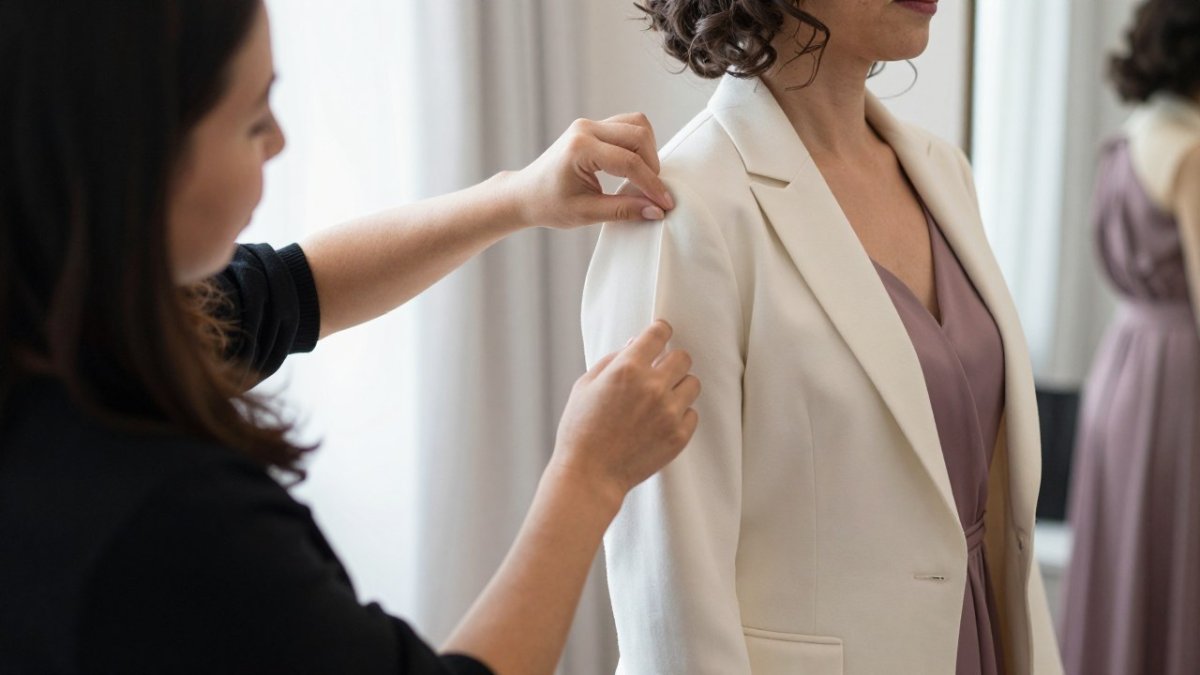
Match the layer to the dress code
- Black tie and formal evening weddings: choose a tailored jacket or a structured cape in a matte fabric such as crepe or duchess satin. A matching jacket dress reads as a complete outfit rather than a dress with something thrown over it. Keep the jacket fitted at the shoulder and short enough to show the waist seam.
- Cocktail and semi-formal weddings: a cropped jacket, a light shrug or a sheer wrap works well. A pashmina in a tone that picks up one colour from the dress is the easiest option and packs flat for travel.
- Outdoor, garden and barn venues: a lightweight wrap or a fine-knit bolero handles uneven ground and cooler air without looking overdressed. Avoid long trains and trailing wraps that catch on grass or gravel.
Choose a fabric that complements the dress
A jacket in the same fabric as the dress looks intentional; a jacket in a contrasting texture looks styled. Matte crepe over a satin dress adds depth without shine, while a lace jacket over a plain crepe dress adds detail.
Watch out: a jacket that is too long or too boxy will hide the waist definition you paid for in the dress.
Coordination with the other parent and the wedding party
Before you buy a layer, ask the couple two questions: what colours the wedding party is wearing, and what the other parent plans to wear. A jacket in the same shade as the bridesmaids will make you look like part of the party in photographs, and two parents in clashing jewel tones can pull the eye away from the couple. A simple rule is to choose a layer one shade deeper or lighter than your dress rather than a completely different colour family.
Seasonal layering and weather planning
- Spring: a light pashmina or a cropped jacket for a ceremony that may start cool and end warm.
- Summer: a sheer wrap for air-conditioned venues and a fan for outdoor ceremonies; avoid heavy linings.
- Autumn: a tailored jacket in a mid-weight fabric, plus a spare wrap for the evening.
Pack the layer, not just wear it: a wrap that folds into a bag is more useful than a jacket you have to carry all evening.
3. Pick Colours That Coordinate Without Clashing
Colour is where many mothers of the bride feel the most pressure. The aim is to complement the wedding palette without upstaging the bride. Ask the couple whether they have a colour scheme, and check whether the wedding party is wearing a particular shade.
Deep, rich tones such as navy, plum, emerald and dusky blue are popular choices. suggests that deep, even-toned colours and tone-on-tone designs can look especially elegant in photographs.
Colours and fabrics to avoid, especially white
Avoid white and near-white outfits entirely. Even ivory or cream can compete with the bride’s dress in photographs.
Be cautious with shiny fabrics, which can reflect flash and show every crease in photos. Our comparison of satin and chiffon for comfort shows how these fabrics drape and feel.
Colour choices that work well for a mother of the bride, and the ones to avoid.
| Colour or fabric | Why | Note |
|---|---|---|
| Navy, plum, emerald, dusky blue | Deep, rich tones suit the day | Popular choices for the outfit |
| White, ivory, cream | Competes with the bride’s dress | Avoid entirely |
| Neon and busy prints | Distract from the ceremony | Use with caution |
| Shiny fabrics | Reflect flash and show creases | Choose a matte finish |
| Crepe, chiffon, soft jersey | Photograph well and feel comfortable | Matte finishes for long days |
4. Plan Comfortable Shoes and Accessories for the Full Day
A wedding day is long, so comfort matters as much as appearance. Choose a shoe with a stable heel or a block heel, and break the shoes in at home before the big day.
Keep accessories simple so they support the outfit rather than overwhelm it.
Pack a small emergency kit with tissues, plasters, a stain pen and spare tights.
5. Book Alterations Early for a Fit You Can Move In
A well-fitting dress matters more than the designer label, and for a plus-size mother of the bride the difference between an off-the-peg dress and a tailored one is usually two appointments and a realistic timeline. Alterations usually need at least two fittings, and a third if the hem or bodice needs reworking. Our wedding dress alteration tips explain what a good fit requires before you book.
A practical fit and tailoring checklist
Use this checklist when you try on your outfit, and again at every fitting:
- Can you sit down, raise your arms and bend forward comfortably?
- Does the bodice sit flat without gaping at the bust or underarm?
- Is the waist seam at your natural waistline, not above or below it?
- Does the hemline suit the shoes you plan to wear, including the heel height?
Bring the shoes and any shapewear you plan to wear to every fitting. Heel height changes how a hem falls, and shapewear changes how a bodice sits. If you plan to wear a bra with a specific neckline, bring that too, a strapless bodice that fits over a everyday bra will not fit the same over a balconette.
Measurements, sizing and undergarments
Take your measurements before you shop, not after: bust, underbust, waist, hip and hollow-to-hem (from the hollow at the base of your neck to the floor in your wedding shoes).
Undergarments do half the work of a good fit. A well-fitted seamless bra, high-waisted smoothing shorts or a slip can stop a skirt clinging and keep a bodice sitting flat.
Watch out: do not buy a dress that is too small in the hope of losing weight before the wedding.
Shopping timeline and budget planning
Work backwards from the wedding date:
- Six to nine months before: start trying styles, confirm the dress code with the couple, and order the dress. Delivery times vary by designer, so check lead times when you order.
- Three to four months before: first fitting. Book it as soon as the dress arrives.
- Six to eight weeks before: second fitting, with shoes and undergarments.
- Two weeks before: final check and collection.
Budget for alterations as a separate line, not as part of the dress price. Alteration costs vary with the work involved, so ask for a quote when you book. If the budget is tight, spend on the fit of the bodice and hem first; accessories and a second pair of shoes can wait. Ask the boutique about trying on styles before you order your size.
Inclusive, body-neutral styling
The aim is not to hide your body but to choose clothes you can move in and feel yourself in. Proportion matters more than size: a defined waist, a neckline that frames your face and a hem that lets you walk confidently will do more than any rule about covering up. If a stylist talks only about minimising or concealing, ask instead what will let you sit, dance and greet guests comfortably, that is the fit that photographs best.
Booking Your Mother of the Bride Appointment at Sofi Designs
At Sofi Designs, every appointment is one-to-one and appointment-only, so you have time to try styles, talk through your options and get honest advice without feeling rushed. Read what to expect at a private bridal appointment to see how a session with us works.
Book your appointment today at Sofi Designs and take the stress out of finding your outfit.
Frequently Asked Questions
What should a plus-size mother of the bride wear?
Choose an outfit that suits the wedding’s formality and your own shape. Many plus-size mothers find A-line dresses, empire waists and wrap styles comfortable and flattering, while jacket dresses and two-piece outfits offer structure and coverage. Pick fabrics that drape rather than cling, and avoid white or near-white, which is reserved for the bride. Booking a one-to-one appointment at Sofi Designs lets a stylist talk through options that fit your body and the day.
How do I choose a flattering mother of the bride dress?
Start with the wedding dress code and venue, then narrow styles by silhouette. Look for a defined or highlighted waist, necklines that frame your face, and sleeves or a jacket if you want more coverage. Try dresses in a few cuts rather than settling on the first one, and bring the shoes and undergarments you plan to wear so the fit is judged realistically.
Should a mother of the bride dress come with a jacket?
A jacket is a practical choice if you want extra coverage for a ceremony, cooler weather or photographs, and it can smarten a simpler dress. Make sure the jacket and dress share a colour or sit in the same tonal family, and check that the jacket stays in place when you sit, stand and raise your arms. Sofi Designs can advise on matching pieces during your appointment.
Do mother of the bride dresses need alterations?
Most formal dresses need some tailoring, particularly around the hem, bust, waist and straps. Plan alterations early, ideally several weeks before the wedding, so there is time for fittings and adjustments. Wear the shoes you intend to wear to fittings, and ask whether the seamstress can adjust fit without affecting the fabric or the dress’s line. Contact Sofi Designs for guidance on alteration timing and expert fitting support.

